

Best plants for shaded backyards in Hamilton County
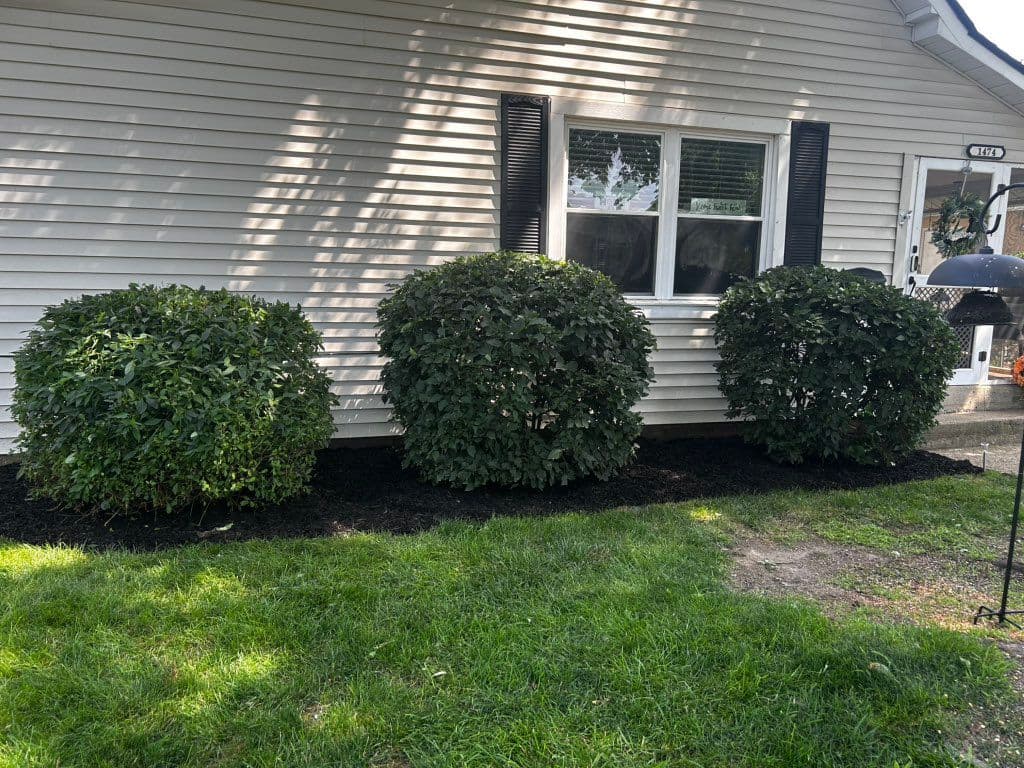
Hamilton County yards run heavy on mature trees — Carmel, Fishers, Westfield, and Noblesville all have neighborhoods with 40-year-old oak and maple canopies that throw most of the backyard into part shade or deep shade by mid-June. Homeowners call us every spring after their full-sun annuals burned out and they want to know what actually thrives without four hours of direct light.
Here are the plants we install most often in shaded Hamilton County backyards, and why.
Hostas (Hosta spp.)
The workhorse. We install more hostas in Hamilton County than any other perennial. They handle our clay soil after a single amendment, they spread reliably, and the foliage carries the bed from May through October even when nothing else is blooming.
For deep shade under mature oaks we use Hosta 'Sum and Substance' (chartreuse leaves, gets to 3 feet across) or Hosta 'Patriot' (white-edged green, classic look). Both are slug-resistant once established. For lighter shade with morning sun, the blue-leaved cultivars — 'Halcyon', 'Krossa Regal', 'Big Daddy' — hold their color better than full-sun varieties. Plant in spring or early fall; we like late September because the soil is still warm but the heat stress is over.
Ferns
Ostrich fern (Matteuccia struthiopteris) and Lady fern (Athyrium filix-femina) are the two we plant most. Ostrich fern reaches 4-5 feet tall and is dramatic against a fence line. Lady fern is shorter at 2-3 feet and works as a softer underplanting around hostas. Both want consistent moisture; they will burn brown in July if you forget to water through a drought week.
Japanese painted fern (Athyrium niponicum 'Pictum') adds silver and burgundy color in shade where everything else is reading green. Slower spreader but worth the patience.
Astilbe
The flowering plant most homeowners do not know but immediately want once they see it. Astilbe throws feathery plumes — white, pink, red, lavender — from June into August, exactly when shade gardens otherwise have no color. Astilbe 'Bridal Veil' (white) and 'Visions' (deep pink) are our go-to cultivars. Wants moist soil; pair it with hostas in a bed that gets watered together.
Hellebores (Lenten rose)
The plant that earns its keep in February. Hellebores bloom in late winter while everything else is dormant, holding flowers from February through April. Evergreen foliage stays attractive year-round. We plant Helleborus orientalis hybrids — the H. x hybridus crosses with colors from white through deep purple. Slow to establish (give them two seasons), then they spread by seed and become a permanent shade-bed anchor.
Native dogwood (Cornus florida and C. alternifolia)
For the back-of-bed structural plant, we go native. Flowering dogwood (Cornus florida) tops out around 20-25 feet and is an Indiana native, supporting native pollinators and bird species the imported ornamentals do not. Pagoda dogwood (Cornus alternifolia) is smaller at 15-20 feet with a horizontal branching habit that looks intentional in shade gardens.
Both prefer the same conditions: part shade, well-drained acid-leaning soil, consistent moisture the first two years. After establishment they handle Indiana drought.
Soil amendments for Indiana clay
Hamilton County clay drains poorly and reads slightly alkaline (pH 7.0-7.5 in most yards we test). For shade plants — which mostly prefer slightly acidic, organic-rich soil — we amend every planting hole. The mix is one third compost (we use leaf mold or pine bark fines), one third existing clay broken up by hand, and one third coarse sand or pine bark for drainage. Dig the hole twice as wide as the rootball and the same depth.
After planting, we top with 2-3 inches of hardwood mulch — never volcano-style against the stem, just a doughnut ring with the stem in the middle. The mulch slowly breaks down and acidifies the soil, which is what most of these plants want anyway.
Watering schedule that actually works
First year, every plant gets a slow soak twice a week unless rain delivers an inch in the same week. We measure rain with a 2-dollar gauge on a fence post. Second year, once a week with a 4-5 gallon soak. Third year and beyond, only during drought stretches longer than two weeks.
The most common mistake we see in Carmel and Fishers yards: irrigation systems set to "lawn" frequency (15 minutes three times a week) for shrub beds. That delivers shallow water that promotes shallow roots, which fail in drought. Better is a deep soak once a week from a hose or a drip line.
Putting it together
A shaded Hamilton County bed we built last fall in Westfield: back row dogwood, mid row hostas alternating with astilbe, front row ferns and hellebores tucked along the edge. Five hundred square feet, three days of work including bed prep and mulch, plant material around 1,800 dollars at retail nursery prices. Two-year guarantee on plant material we install.
If you want a designed shade bed for your Carmel, Fishers, Westfield, or Noblesville backyard, we do walk-through assessments free. We bring plant samples on the second visit so you can see leaf texture and color in your own light. Schedule through our landscape design service or our planting service for smaller installations.